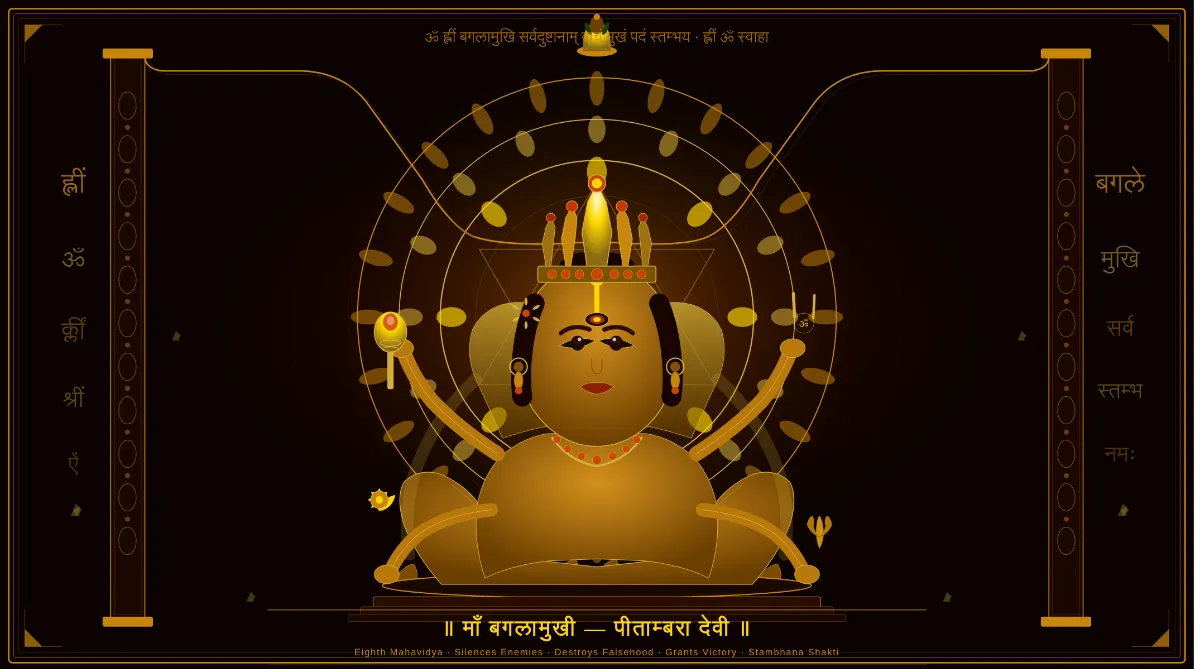
Maa Bagalamukhi is the eighth of the ten Mahavidyas — the ten aspects of the great cosmic wisdom of Adi Shakti in Hindu Tantra. She is the goddess of divine paralysis — the power to silence enemies, stop black magic, and destroy falsehood. She is worshipped for victory in legal battles, protection from enemies, and removal of obstacles.
Her name carries deep meaning. Bagala is a transformation of the Sanskrit word Valga, meaning bridle or control. Mukhi means "one who has a face" or "one who is the head of." Together, Bagalamukhi means the goddess who holds the bridle — she who controls and stops all forces at will.
She is especially revered in Himachal Pradesh, Datia (Madhya Pradesh), and Nagpur. Worship on Tuesdays and during Bagalamukhi Jayanti is considered most auspicious, and her primary mantra — beginning with the beej Hleem — is among the most powerful in the entire Tantric tradition.
✦ Key Highlights
- ●Maa Bagalamukhi is the eighth Mahavidya among the ten cosmic wisdom goddesses in Hinduism.
- ●Her primary power is stambhan — the ability to paralyze, silence, and stop negative forces.
- ●She is worshipped in a vivid yellow form, seated on a golden throne.
- ●Her primary mantra is one of the most powerful in the entire Tantric tradition.
- ●She is especially revered in Himachal Pradesh, Datia (Madhya Pradesh), and Nagpur.
- ●Worship on Tuesdays and during Bagalamukhi Jayanti is considered most auspicious.
- ●She is called the goddess of victory over enemies, false accusation, black magic, and legal battles.
- ●Yellow color, turmeric, and Tuesday are her sacred identifiers.
- ●Most powerful temple is Pitambara Peeth, Datia, Madhya Pradesh.
- ●Her mantra begins with the beej Hleem and is chanted 108 times.
Spiritual Background and Origin Story
The story of Maa Bagalamukhi's origin appears primarily in the Devi Bhagavata Purana and various Tantric texts.
Once, in the ancient past, a devastating storm threatened to destroy all of creation. The sky turned black, the oceans roared with catastrophic waves, and all life on earth trembled at the edge of annihilation. The universe itself faced dissolution. The gods, helpless and terrified, gathered at the sacred lake called Haridra Sarovar (the lake of turmeric) in the land of Saurashtra and prayed desperately to Adi Shakti, the supreme mother energy.
Moved by their devotion and the genuine threat to creation, Adi Shakti manifested from the golden-yellow waters of Haridra Sarovar in a form of blazing light. This divine form instantly paralyzed the storm, silenced the chaos, and restored cosmic order. This magnificent form of Adi Shakti became known as Bagalamukhi — the one who holds the power to stop, silence, and still all that is destructive.
The Significance of Haridra Sarovar
The sacred lake Haridra Sarovar — the lake of turmeric — is central to understanding Maa Bagalamukhi's identity. Her golden-yellow complexion, her identification with turmeric, and the yellow color used in all her worship trace directly back to this origin. She is born from and resides in Haridra Sarovar — yellow is not merely a ritual preference, it is her essential nature.
Maa Bagalamukhi is one of the ten Mahavidyas — the ten aspects of the great cosmic wisdom of Adi Shakti. The ten Mahavidyas represent ten transformative paths to liberation, and Bagalamukhi represents the path of stambhan shakti — the power of divine stillness and halt.
She is the goddess of the divine pause — the sacred moment when all harmful energy is frozen, all false accusations are silenced, and all enemies of truth are rendered powerless. Her iconography is precise and deeply symbolic.
The primary mantra of Maa Bagalamukhi is among the most powerful in all of Tantric worship. It is used for protection, victory in legal battles, silencing enemies, and removing obstacles.
Correct pronunciation is essential in mantra japa. Even small mispronunciations can reduce the efficacy of the chant. Follow this step-by-step guide for each key word in the mantra.
Sit facing east or north. Wear yellow clothes if possible. Use a haldi mala (turmeric rosary) or a crystal rosary. Chant the mantra 108 times per sitting. The minimum commitment for results is 11 days of continuous chanting at the same time each day. For major problems, a 21-day or 41-day sadhana is recommended.
Maa Bagalamukhi's worship carries both profound spiritual benefits and practical benefits in everyday life. Understanding both dimensions helps the devotee approach her with the right intention and expectation.
Spiritual Benefits
- Liberation from fear, black magic, and negative energy
- Awakening of inner power and confidence
- Protection of the mind from confusion and deceit
- Progress on the Tantric path toward moksha
- Development of vak siddhi — the power of speech that manifests
Practical Benefits
- Victory in legal disputes and court cases
- Protection from enemies and professional rivals
- Silencing of false accusations and harmful speech
- Neutralization of business rivals and competition
- Removal of evil eye and psychic attacks
- Grants power and authority in speech and communication
The puja of Maa Bagalamukhi follows a specific ritual methodology rooted in Tantric tradition. Correct procedure is essential — the goddess is powerful and her worship should be approached with precision, purity, and sincere devotion.
What you need: Yellow flowers (especially marigold), turmeric (haldi), yellow cloth, ghee lamp, yellow sweets (besan laddoo or yellow barfi), haldi mala, image or yantra of Maa Bagalamukhi.
1
Wake before sunrise, bathe, and wear yellow clothes Purity of body is the first requirement. Yellow clothing aligns you with her energy from the very beginning of the worship.
2
Sit on a yellow asana (mat) facing east East is the direction of the rising sun and is considered most auspicious for mantra japa and deity worship.
3
Place the image or yantra of Maa Bagalamukhi on a clean altar covered with yellow cloth The altar must be clean and covered entirely in yellow. Place the image or yantra at eye level if possible.
4
Light a ghee lamp and incense. Offer yellow flowers Marigold flowers are her most preferred offering. The ghee lamp should remain lit throughout the entire puja.
5
Offer turmeric paste to the deity This is her most loved offering. Apply a small amount of haldi paste to the image or yantra with devotion.
6
Offer yellow sweets as prasad Besan laddoo or yellow barfi are the traditional prasad. The color must be yellow — red or white sweets are not appropriate.
7
Recite the Bagalamukhi Kavach (protective prayer) first The Kavach is a protective shield — it must be recited before the mantra japa begins. Skipping it leaves the sadhaka energetically exposed.
8
Chant the Mool Mantra 108 times with full concentration Use a haldi mala to count. Maintain concentration throughout — distraction reduces the power of the japa.
9
Offer water as arghya (ritual offering) while chanting Offer water from cupped hands toward the deity image while reciting the offering mantra.
10
Conclude with aarti and distribute yellow prasad Perform the aarti with the ghee lamp in a circular motion. Distribute the yellow sweets as prasad to family members or visitors.
Timing is an important dimension of Bagalamukhi worship. The Tantric tradition identifies specific days, times, and occasions when her energy is most accessible and her worship most potent.
Here are four practical scenarios that show how Maa Bagalamukhi's worship applies to different situations devotees commonly face.
Example 1: Legal Battle — Court Case Protection
Scenario
A devotee is facing a false accusation in court. The case has been dragging for months and the person feels vulnerable and anxious.
Recommended practice: Begin an 11-day mantra sadhana on a Tuesday. Chant the Mool Mantra 108 times daily at Brahma Muhurat. Write the specific intention on yellow paper with turmeric ink and place it under the yantra.
The principle: Maa Bagalamukhi's stambhan shakti works to silence false speech and paralyze the forces working against truth.
Example 2: Protection from Black Magic — Daily Kavach Practice
Scenario
A devotee believes they are under the influence of black magic or evil eye — experiencing repeated obstacles, health issues, and unexplained failures.
Recommended practice: Recite the Bagalamukhi Kavach every morning after bathing. Offer turmeric and yellow flowers on Tuesdays. Continue for 21 days minimum.
The principle: The Kavach creates a divine shield that progressively dissolves negative energetic influences.
Example 3: Competitive Examination — Mental Sharpness
Scenario
A student is preparing for a competitive government examination and needs mental clarity, focus, and the ability to recall and express knowledge effectively.
Recommended practice: Chant the Beej Mantra (Hleem) 108 times daily at a fixed time. Place the Bagalamukhi yantra at the study table. Offer yellow flowers on Ashtami.
The principle: Maa Bagalamukhi grants vak siddhi — the power of speech and expression that manifests — which includes the ability to recall and communicate knowledge with authority.
Example 4: Extended Sadhana — 41-Day Tantric Practice
Scenario
A serious Tantric sadhaka undertakes a 41-day Bagalamukhi sadhana for spiritual siddhi and deep transformation.
Requirements: Proper diksha (initiation) from a qualified guru. Strict celibacy. Vegetarian diet. Brahma muhurat daily chanting of 1,008 repetitions of the Mool Mantra. Yellow throughout — clothes, flowers, food, and altar.
Key caution: Never begin and abandon this practice mid-way. The energy field created by the sadhana must be completed or properly closed by an experienced practitioner.
Correct Practice
- Begin with the Kavach before every japa session
- Use yellow flowers, turmeric, and yellow sweets only
- Maintain continuity — same time, same place every day
- Seek proper diksha from a guru for 41-day Tantric sadhana
- Use the mantra for protection of truth, not harm to innocents
- Complete the full sadhana once begun
Common Mistakes
- Chanting major sadhana mantra without initiation from a guru
- Using the mantra to harm an innocent person — this rebounds on the practitioner
- Skipping the Kavach before japa — leaves the sadhaka energetically exposed
- Irregular chanting — starting and breaking continuity is ineffective and disruptive
- Offering red or white flowers instead of yellow ones
- Abandoning a sadhana mid-way without proper closure
Maa Bagalamukhi's worship is powerful and accessible — but it is especially recommended for specific situations where her stambhan shakti is most needed.
- Those facing false accusations, court cases, or legal battles — her mantra is among the most widely used for this purpose across India
- People experiencing threats from enemies or professional rivals — whether in politics, business, or personal life
- Individuals under the influence of black magic or evil eye (nazar) — her Kavach is one of the most powerful protective prayers in the Tantric tradition
- Politicians, lawyers, and public figures needing protection and victory in competitive or adversarial situations
- Students appearing for competitive examinations seeking mental sharpness and the power to express knowledge effectively
- Anyone experiencing sudden obstacles and repeated failures despite honest effort — where unseen forces seem to be at work
- Spiritual seekers on the Tantric path seeking siddhi and liberation through the eighth Mahavidya
Scripture References and Traditional Sources
Maa Bagalamukhi's origin and worship are documented across multiple sacred texts. The Devi Bhagavata Purana contains her origin story in Haridra Sarovar and her manifestation to stop cosmic destruction. The Shakta Pramoda contains the detailed Bagalamukhi Kavach and Stotra. The Tantrasara provides mantra methodology and Tantric protocols for her sadhana. The Mantra Mahodadhi is the procedural guide for mantra japa and havan (fire ritual). The Mundamala Tantra references her as the goddess of paralysis of evil forces.
Misuse of stambhan shakti: Maa Bagalamukhi is a protector of truth — not a weapon for personal vendettas. Using her energy to harm an innocent person is considered a severe spiritual violation in Tantric tradition that rebounds on the practitioner with full force.
Sadhana without proper initiation: Daily prayer and basic japa are accessible to all sincere devotees. But the 41-day Tantric sadhana carries significant energetic weight — undertaking it without diksha from a qualified guru is widely cautioned against in traditional texts.
Abandoning mid-way: The most commonly observed practical risk. Starting a mantra sadhana and breaking continuity is considered not just ineffective but potentially disruptive to the practitioner's energy field. Always complete what is begun, or formally close the practice with proper ritual closure.
Wrong color offerings: Offering red flowers instead of yellow, or white sweets instead of yellow ones, is one of the most frequently observed errors in Bagalamukhi worship. Yellow is non-negotiable — it is not a preference but an essential identity of the goddess herself.
Maa Bagalamukhi is often misunderstood as a goddess of aggression or destruction. She is not. She is the goddess of divine truth. Her power does not harm the innocent — it only paralyzes that which is false, harmful, and unjust.
The Pitambara Peeth in Datia, Madhya Pradesh — the most famous Bagalamukhi temple in India — draws devotees from across the country, including political leaders, military officers, judges, and government officials seeking divine intervention before critical decisions. The scale and range of devotees at this single temple speaks to the universal human recognition of the need for a force that silences falsehood.
In 2026, Maa Bagalamukhi's worship continues to grow among urban professionals — lawyers, executives, and public figures — who combine traditional practice with modern life. The Pitambara Peeth reports record numbers of visitors during Bagalamukhi Jayanti and court season in India, as devotees from across the country seek her blessing before high-stakes legal proceedings.
In a world where lies often seem louder than truth, where the powerful often silence the sincere, Maa Bagalamukhi stands as the eternal corrective force. She is the cosmic bridle that stops the stampede of falsehood. When you worship her with sincerity, purity of intention, and devotion, you are not asking for revenge — you are aligning yourself with the force of divine truth, and truth, in the end, always silences the false.
Maa Bagalamukhi is the eighth Mahavidya — born from Haridra Sarovar, robed in gold, armed with a mace, and holding the tongue of all that is false. Her core power is stambhan: the divine ability to paralyze evil, silence lies, and stop destructive forces at the precise moment they must be stopped.
The practical starting point: begin with the Kavach for protection, add the Mool Mantra chanted 108 times on a Tuesday at Brahma Muhurat, offer turmeric and yellow marigolds, and maintain the practice with continuity and purity of intention. For those facing genuine injustice, repeated obstacles, or the weight of enemies both seen and unseen — Maa Bagalamukhi is the goddess who answers.
Jai Maa Bagalamukhi.