✦ Key Highlights
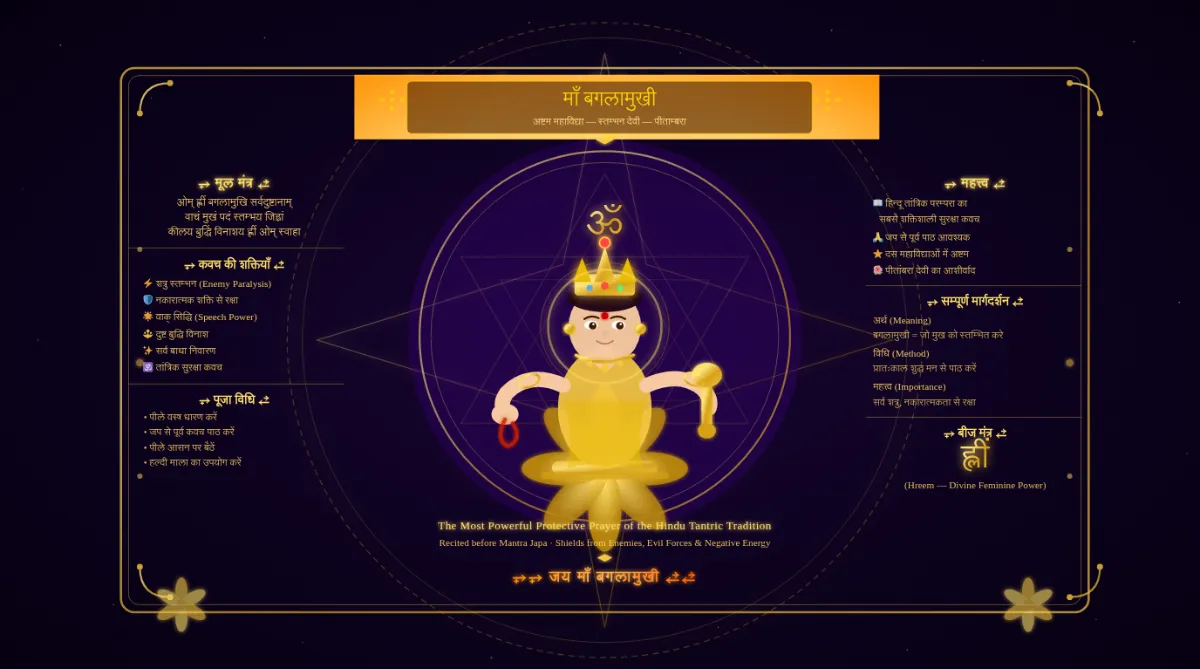
- ●Maa Bagalamukhi is the eighth Mahavidya among the ten cosmic wisdom goddesses in Hindu Tantra.
- ●She is born from the golden-yellow waters of Haridra Sarovar — the sacred turmeric lake — according to the Devi Bhagavata Purana.
- ●Her primary divine power is stambhan — the ability to paralyze, silence, and completely stop all negative forces.
- ●She appears in a blazing yellow-golden form, seated on a golden throne in the middle of an ocean of nectar.
- ●She pulls the tongue of a demon with her left hand and strikes him with a golden mace in her right — symbolizing the silencing of falsehood.
- ●Her primary beej mantra is Hleem — one of the most powerful seed syllables in the entire Tantric tradition.
- ●She is especially worshipped at Pitambara Peeth in Datia, Madhya Pradesh — India's most famous Bagalamukhi temple.
- ●Worship on Tuesdays, Ashtami, and Bagalamukhi Jayanti is considered most auspicious.
Spiritual Background and Origin Story
The story of Maa Bagalamukhi's origin is recorded in the Devi Bhagavata Purana and elaborated in various Tantric texts including the Shakta Pramoda and the Mundamala Tantra.
In the ancient past, during the Satya Yuga, a catastrophic storm of unprecedented power rose over the universe. This was not an ordinary storm. It was a cosmic destruction event — a Pralaya-level calamity that threatened to annihilate all of creation. The sky turned black. The oceans rose with terrifying force. Mountains shook. Every living being trembled at the edge of complete annihilation. The gods themselves — Brahma, Vishnu, Mahesh — were helpless before its fury.
In complete desperation, all the gods gathered at the shore of a sacred lake called Haridra Sarovar in the region of Saurashtra — a golden lake whose waters were the color of turmeric, warm and luminous even in the darkness of the storm. Together they prayed with absolute surrender to Adi Shakti — the supreme mother consciousness that underlies all existence.
Moved by their sincerity and the genuine threat to all of creation, Adi Shakti stirred within the golden waters of Haridra Sarovar. A blinding light emerged from the lake's depths. A goddess rose — golden-complexioned, blazing with divine energy, wearing yellow garments and yellow ornaments, seated on a golden throne. The moment she appeared, the cosmic storm froze. The raging oceans stilled. The destruction halted completely. Not gradually — instantly.
This goddess, born from the turmeric-colored lake to freeze cosmic destruction, became known as Bagalamukhi. She demonstrated, in that first moment of her existence, the very power that defines her — the divine power to stop, silence, and paralyze all destructive force at will.
The name Bagalamukhi is composed of two Sanskrit roots that have been interpreted across different Tantric texts in two primary ways.
Both interpretations point to the same truth. Maa Bagalamukhi is the goddess of divine control. She does not destroy in the way Kali destroys. She does not transform in the way Tara transforms. She stops. She freezes. She holds the bridle of the universe and pulls — and everything that is harmful, false, or destructive comes to a complete halt.
Maa Bagalamukhi is the eighth of the ten Mahavidyas — the ten cosmic wisdom goddesses who represent ten distinct paths to liberation and ten aspects of Adi Shakti's infinite power.
Among all ten Mahavidyas, Bagalamukhi holds a particularly unique position. While most of the Mahavidyas govern broad cosmic forces, Bagalamukhi is the specialist — she governs one specific, extraordinary power: the power to stop. And in that specialization lies her unique and devastating effectiveness for devotees facing urgent earthly problems.
The iconographic form of Maa Bagalamukhi is precise and deeply symbolic. Every element of her appearance carries specific spiritual meaning.
The mantra tradition of Maa Bagalamukhi is among the most powerful and carefully preserved in all of Hindu Tantrism.
The beej mantra Hleem is the sonic form of Bagalamukhi's divine energy. It is the compressed essence of her entire power expressed in a single syllable. When chanted with concentration, it carries the full stambhan shakti of the goddess.
Word-by-word meaning of the Mool Mantra:
Sit facing east or north. Wear yellow clothes. Use a haldi mala (turmeric rosary) or a crystal mala. Keep the spine straight and eyes gently closed. Chant 108 times per sitting minimum. The ideal commitment for results is an 11-day continuous sadhana at the same time each day without interruption. For major life problems, a 21-day or 41-day sadhana is the traditional recommendation.
Spiritual Benefits
- Liberation from fear at the deepest level — including fear of enemies, death, and failure
- Development of vak siddhi — the power of speech that manifests in reality
- Awakening of inner confidence and divine authority
- Protection of the mind from confusion, deceit, and psychic manipulation
- Accelerated progress on the Tantric path toward liberation
- Direct experience of Shakti as stambhan — the power of divine stillness
Practical Benefits
- Legal disputes and court cases: Her mantra is widely chanted before hearings for victory and favorable judgment
- Political and competitive life: Grants victory over rivals, opponents, and political enemies
- False accusations: Silences those who speak lies and spread false information against the devotee
- Black magic and evil eye: Removes and neutralizes all forms of psychic attack and harmful occult influence
- Business competition: Neutralizes business rivals and removes unfair obstacles to success
- Examination and career: Sharpens the mind, removes mental blocks, and grants clarity and performance
- Speech and communication: Grants power, authority, and persuasive ability in all forms of communication
Items required: Yellow flowers (marigold), turmeric powder, haldi mala, yellow cloth for altar, ghee lamp, incense, yellow sweets (besan laddoo or yellow barfi), image or yantra of Maa Bagalamukhi, copper or brass plate, Ganga jal (holy water), camphor.
1
Wake before sunrise. Bathe and wear yellow clothes This is non-negotiable in Bagalamukhi worship. Yellow clothing aligns the devotee's energy with the goddess from the very beginning.
2
Sit on a yellow asana (mat) facing east East is the direction of the rising sun and is most auspicious for all mantra japa and deity worship.
3
Place the image or yantra of Maa Bagalamukhi on an altar covered with clean yellow cloth The altar must be clean and entirely covered in yellow. Place the image or yantra at eye level if possible.
4
Light a ghee lamp with a cotton wick and incense Light incense — preferably sandalwood or gugal. The ghee lamp must remain lit throughout the entire puja.
5
Offer yellow marigold flowers to the deity Do not offer red or white flowers. Yellow is non-negotiable — it is not a preference but an essential identity of the goddess herself.
6
Apply turmeric paste to the image or yantra This is Bagalamukhi's most sacred and beloved offering, tracing directly to her origin in Haridra Sarovar.
7
Offer yellow sweets as naivedya (food offering) Besan laddoo or yellow barfi are the traditional prasad. The color must be yellow — red or white sweets are not appropriate.
8
Recite the Bagalamukhi Kavach before the mantra The Kavach is the protective prayer that shields the worshipper during powerful Tantric practice. Skipping it leaves the sadhaka energetically exposed.
9
Chant the Mool Mantra 108 times with full concentration Use the haldi mala to count. Maintain concentration throughout — distraction reduces the power of the japa.
10
Offer water as arghya while chanting her name A simple ritual offering of water poured from cupped hands toward the deity while chanting "Om Bagalamukhi Namah."
11
Perform aarti Wave the ghee lamp in a clockwise circle before the image while chanting the goddess's name or a devotional song.
12
Distribute yellow prasad to all present The puja is complete. Distribute yellow sweets to family members or visitors. Do not waste prasad.
Correct Practice
- Always state your full name and specific sankalp before beginning japa
- Use the mantra only for protection of truth — never against innocent people
- Offer only yellow flowers and yellow sweets — never red or white
- Always recite the Kavach before the mantra without exception
- Commit to at least 11 continuous days before evaluating results
- Fix one specific time — ideally Brahma Muhurat — and maintain it without deviation
Common Mistakes
- Chanting without a clear sankalp — Bagalamukhi's power is focused and targeted, not general
- Using her mantra for unjust purposes — the energy rebounds on the practitioner with full force
- Offering red flowers, white sweets, or non-yellow items — yellow is a fundamental requirement, not a preference
- Skipping the Kavach — leaves the practitioner energetically exposed during powerful Tantric practice
- Expecting immediate results without sustained practice — commit to at least 11 continuous days
- Inconsistent timing — chanting at different times each day disrupts the energetic rhythm of the sadhana
"When beginning a Bagalamukhi sadhana for a specific problem — particularly a legal case, enemy threat, or black magic situation — take a small piece of yellow paper and write your specific intention in turmeric ink or yellow pen. State clearly what you want the goddess to do. Fold this paper and place it under your puja thali or beneath the yantra at the start of your first day. Do not remove it until your sadhana is complete. This act of likhit sankalp — written divine intention — is used by experienced practitioners at Pitambara Peeth and significantly focuses the mantra's energy on your specific need rather than allowing it to remain general and diffuse."
Maa Bagalamukhi's worship is especially recommended for:
- Those facing false accusations, court cases, or serious legal battles where truth is on their side
- People experiencing threats from known or unknown enemies — personal, professional, or spiritual
- Individuals under the influence of black magic, evil eye, or deliberate psychic harm
- Politicians, lawyers, military personnel, and public figures who require divine protection and competitive advantage
- Students and professionals facing competitive examinations or high-stakes career decisions
- Anyone experiencing sudden, repeated, and unexplained obstacles despite sincere and honest effort
- Business owners, entrepreneurs, and investors facing unfair competition and deliberate sabotage
- Spiritual seekers on the Tantric path who seek to develop vak siddhi and deeper connection with the Mahavidyas
Related Beliefs and Scriptures
In the Tantric tradition, Maa Bagalamukhi is closely associated with the concept of vak siddhi — the perfection of speech. The Matangi Tantra and various Shakta texts describe how advanced practitioners of Bagalamukhi mantra develop an extraordinary power: their words begin to manifest in reality. What they speak comes true. The connection between Bagalamukhi and the crane (bagula bird) is also significant — the crane stands absolutely still in water, then strikes with lightning precision at exactly the right moment. This is the divine strategy of Maa Bagalamukhi: absolute stillness before absolute, decisive action. The Pitambara Peeth in Datia is considered the most powerful seat of Bagalamukhi energy on earth, drawing devotees from every walk of life for centuries.
Using the mantra for unjust purposes: Maa Bagalamukhi is the protector of truth. Using her energy against an innocent person is a severe spiritual violation that causes the energy to rebound on the practitioner with full force.
Skipping the Kavach: Many devotees jump directly to the mantra without reciting the protective Kavach first. The Kavach creates a spiritual shield around the practitioner. Skipping it leaves one energetically exposed during powerful Tantric practice.
Expecting immediate results without sustained practice: Bagalamukhi's power is real but it responds to sustained, sincere practice. A single day of chanting for complex problems is not sufficient. Commit to at least 11 continuous days before evaluating results.
Advanced sadhana without diksha: For 41-day Tantric sadhana, proper initiation from a qualified guru is strongly recommended. Undertaking it without diksha carries significant energetic weight and risk.
Maa Bagalamukhi is perhaps the most misunderstood of the ten Mahavidyas. People fear her. They treat her as a weapon. They approach her only in crisis.
But those who truly know her understand something far deeper. She is not a goddess of war. She is a goddess of truth. Her power does not harm the innocent — it cannot. She paralyzes only what is false, only what is harmful, only what works against the natural order of dharma and satya.
When you worship Maa Bagalamukhi with sincerity, purity, and clarity of intention, you are not asking for power over others. You are asking for alignment with truth. You are asking the cosmic force that silences all falsehood to stand with you — because you are on the side of what is right. And when truth stands with you, nothing can stand against you.
This is the deepest wisdom of Maa Bagalamukhi.
Jai Maa Pitambara. Jai Maa Bagalamukhi.
Maa Bagalamukhi is the eighth Mahavidya — born from the golden Haridra Sarovar to stop cosmic destruction. Her core power is stambhan — the divine ability to paralyze, silence, and stop all evil forces instantly. Yellow color, turmeric, and Tuesday are her three most fundamental identifiers — non-negotiable in worship. Her Mool Mantra begins with Hleem — one of the most powerful beej mantras in the entire Tantric system. She is best worshipped at Brahma Muhurat on Tuesdays, or on Bagalamukhi Jayanti in May. The most powerful and authentic temple of Maa Bagalamukhi in India is the Pitambara Peeth in Datia, Madhya Pradesh. She protects truth — using her power against innocent people is a serious spiritual violation. Sustained practice of minimum 11 days is required for her energy to fully manifest in the devotee's life.